The Shifting Metaphor in Robert Frost’s ‘Birches’
Nayantara Maitra Chakravarty
Robert Frost had claimed that he wrote Birches with “one stroke of a pen,” however, evidence suggests that he made several attempts to write the poem, and refined it over the years, even after it was first published in 1915. It was only in 1949 that it appeared in its final preferred form. Frost painstakingly polished each phoneme, paying attention to what it would sound like when being read out. The poem first appeared in print in The Atlantic Monthly, in July 1915. It was reprinted in the book Mountain Interval in 1916. Even after that Frost made some important changes when Birches was reprinted in later collections of his poems.
Although Frost wrote the poem when he was in England, the idea of swinging birches came from his own experience as a child in New England, USA, where boys would commonly swing birches. As he wrote in 1951,
“The first birches were trees I swung near the district school I went to in Salem, New Hampshire.”
A friend taught him how to “climb birches and ride them down.” This is described both in great detail and through similes (” With the same pains you use to fill a cup/ Up to the brim, and even above the brim”) in Birches. Frost wrote a parallel poem for girls, Wild Grapes, at the request of Susan Ward Hayes, who was the literary editor of The Independent, “the first editor ever to publish me.” Hayes was too light to be able to bring the birch tree “to earth.” But she still
“clenched her hands in memory of the pain of having had to hang on in the tree too long.”
In both poems, the bent tree is seen as an intermediary between heaven and earth, between the material and the spiritual. Frost was a critic of the scientistic belief that cold, hard, logic could explain everything. He believed that science needed to acknowledge the value of imagination and the ability of metaphors to capture human experience. One can see this clearly in Birches, where Frost gives us a very ‘material’ description of the process by which birch trees get bent because of snow-storms, only to be told that the poet, himself, would have preferred if this was not just a material phenomenon, but the result of a boy’s play.
The words are used carefully to recreate sights and sounds for the reader (or listener) – it is almost as if a camera had captured it on film. The birch trees are “loaded with ice”, and since it is a sunny morning, when the “breeze rises” and makes the branches sway and “click” against each other, the sunlight gets refracted through the “crystal shells” that cover the birch branches, and “turn many-colored.” This material process poses dangers as well, because the ice crystals are shed “shattering and avalanching” like “broken glass.” In a sense, Frost is saying that this very ‘scientific’ and ‘true’ description, poses a danger to human imagination, destroying the spiritual – “You’d think the inner dome of heaven had fallen.”
We are now brought back to the world of metaphor, away from pure matter. We have already been told about the “dome of heaven” falling, and we are soon introduced to the metaphoric use of the female-form as a simile for the birches. Indeed, while Frost makes the activity of swinging the trees a masculine pastime, done by a boy, but the bent over birches are themselves likened to “girls on hands and knees that throw their hair/ Before them over their heads to dry in the sun.” Frost would continue to see birches as feminine, referring to birches on his farm in South Shaftsbury as his “lady trees.”
Frost immediately reinstates metaphor and imagination as the right way to experience the birches, almost as an assertion against the ‘truth’ of science. It is as if he is apologising for letting ‘science’ intrude for so long into the poem. Thus he writes,
“But I was going to say when Truth broke in / With all her matter-of-fact about the ice-storm/ I should prefer to have some boy bend them/ As he went out and in to fetch the cows—”
This is consistent with Frost’s constant endeavour to make scientists see the metaphorical quality of their scientific statement. Thus he wrote,
“Materialism is not the attempt to say all in terms of matter. The only materialist—be he poet, teacher, scientist, politician, or statesman—is the man who gets lost in his material without a gathering metaphor to throw it into shape and order. He is the lost soul”
Someone who only deals with matter is a “lost soul”, but in Birches, the boy who “summer or winter” has to “play alone,” — because he is “too far from town to learn baseball” — is not lost, because he has an idealised relationship with nature by swinging birches. Once again, there is a near cinematic description of how boys “conquered” birches by swinging them:
“He learned all there was/ To learn about not launching out too soon/And so not carrying the tree away/ Clear to the ground. He always kept his poise/ To the top branches, climbing carefully/ With the same pains you use to fill a cup/ Up to the brim, and even above the brim./ Then he flung outward, feet first, with a swish,/ Kicking his way down through the air to the ground.”
The boy is happy to play on his own, “summer or winter” as he “subdued his father’s trees.” This is a nostalgic imagination because the poet tells us “So was I once myself a swinger of birches/ And so I dream of going back to be.” One would think that Frost is talking about his own rural upbringing, of tending cows, and being in a state of play with nature. However, this is purely an imagined past, a metaphor for the loss of innocence of adult-life, because Frost himself grew up in Lawrence, a city in Massachusetts. His own memories of swinging branches were from an urban setting.
But by the time Frost wrote the first version of Birches, he was already devoting himself to write about the country. In a letter to his friend John Bartlett, probably written in August 1913, Frost wrote,
“One of the curious fatalities in our lives is that without collusion we have simultaneously turned our minds to run on rusticity.”
The idyllic picture he paints of the boy and the birches is one of isolation, and creative play. It is a space to which one can escape, when one is “weary of considerations” of one’s present conditions, where life has become unfamiliar and difficult to navigate, such that it is like “a pathless wood/ Where your face burns and tickles with the cobwebs/ Broken across it, and one eye is weeping/ From a twig’s having lashed across it open.”
Let us recall how Frost had set up the woods in the very first three lines of the poem:
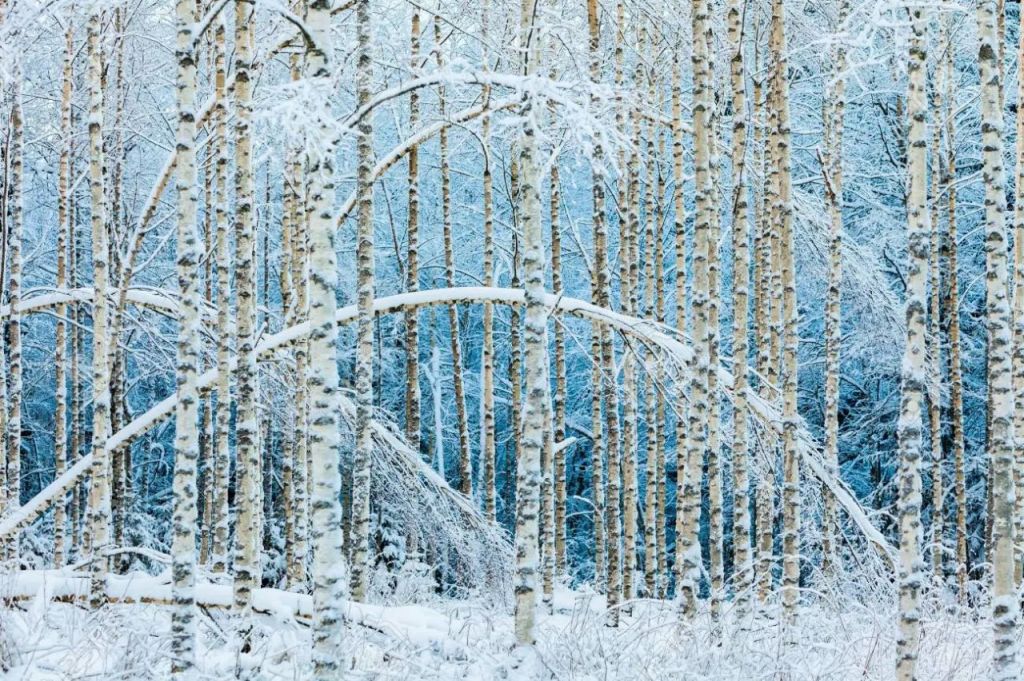
“When I see birches bend to left and right/ Across the lines of straighter darker trees,/ I like to think some boy’s been swinging them.”
The birches are bent, as if under the weight of age, in contradistinction to the straighter darker trees, which are probably younger and haven’t greyed. This is the poet’s present reality, but he wishes he could imagine it differently, as caused by a boy at play. We have already been given the structure of what the poem sets out to do – talk about life’s drudgeries and how good it would be to escape it.
The metaphoric use of birches keeps changing as we move through the poem. When we are first introduced to the image of the bent birches, they represent a human being, so bent over by the cares of the world, that they can never return to their ‘free’ state, even when these cares fall away. Later, the birches represent life itself, which can be “conquered”, the “stiffness” taken out of it, and rendered “limp” by a (rustic) boy at play. Finally, the poem takes a turn to the first person of an ageing man recalling a carefree boyhood (“I was myself once a swinger of birches”), which he wishes to return to (“And so I dream of going back to be.”) At this point, the metaphoric role of the birches change again,
“I’d like to go by climbing a birch tree,
And climb black branches up a snow-white trunk
Toward heaven, till the tree could bear no more,
But dipped its top and set me down again.”
At this stage the birch has become a metaphoric ladder that can take the poet toward heaven. Frost italicises the word ‘toward’ deliberately to remind us of Jacob’s Ladder, the stairway to heaven from the Old Testament. Yet, this move away from earth is only a momentary withdrawal, because the birches rise up, but bend down to the earth again. Indeed, Frost makes it clear that he does not want this escape to be mistaken for death. He writes,
“May no fate willfully misunderstand me/ And half grant what I wish and snatch me away/ Not to return.”
Because this life might be full of cares and problems, it is still the best place to be ( “I don’t know where it’s likely to go better.”) Frost affirms life and living, even if he seeks alleviation, because without life there can be no human connection, no love (“Earth’s the right place for love.”)
One could argue that Birches is internally inconsistent. It seems to suggest the weight of the world bends people forever, and freedom lies in escaping it. At the same time, it seems to reaffirm life, and holds the promise of a renewed future, where one can “come back to it and begin over.” Frost himself seemed to allude to this inherent contradiction in an essay written 35 years after Birches was first published.
“‘Birches’ is two fragments soldered together so long ago I have forgotten where the joint is”
However, Frost would not have considered this to be a problem at all. He did not believe that poetry should have the certitude of science, nor that metaphors need to be explained. Poetry according to him was about ‘belief’, not analysis. In a lecture he gave at Amherst College in 1931, Frost elaborated on this idea of literary belief –
“Every time a poem is written, every time a short story is written, it is written not by cunning, but by belief. The beauty, the something, the little charm of the thing to be, is more felt than known.”
It is important, therefore, for us as critical readers to approach Birches in the same manner, by feeling and believing it, even as we seek to break it down for analysis.
References:
- Schichler, Robert L. ‘Several Strokes to Perfection: Deliberate Artistry in Robert Frost’s “Birches”’ The Robert Frost Review, No. 25, Fall 2015, pp. 39-69.
- Gades, Naomi, C. ‘Cracked Knowledge: The Epistemology of Robert Frost’s ‘Birches’’ The Robert Frost Review, No.2, Fall 2017, pp 14-26
- Ellis, James, ‘Robert Frost’s Four Types of Belief in ‘Birches.’’ The Robert Frost Review, No.3 Fall 1993, pp. 70-74.
- Frost, Robert, ‘Education by Poetry’ Amherst Graduates Quarterly, February 1931
 De Omnibus Dubitandum