Books
Jane Eyre: A Review

“ Do you think I am an automaton? – a machine without feelings? And can bear to have a morsel of bread snatched from my lips, and my drops of living water dashed from my cup? Do you think, because I am poor, obscure, plain and little, I am soulless and heartless? You think wrong!”
‘Jane Eyre’ by Charlotte Bronte is romance set in the Victorian era. It would, however, be a disservice to the novel to limit it to the genre of romance – It is, in reality, a radical story of a strong female character finding her way and holding her own in a male dominated world. Considered to be one of the first feminist novels, the book holds you from beginning to end and has elements of comedy, romance action and suspense.
From the very beginning, Jane is set apart not by her looks but by her intellect. Though ‘plain’ she is ‘strong-willed’, ‘passionate’ and ‘outspoken’. She shuns a comfortable life in the pursuit of true love and equality, and breaks the social conventions of her age. The novel ‘Jane Eyre’ was unique and pioneering in its depiction of women and their place in society.
Mr. Rochester is a rude impetuous man with a secret. Though at first one might think of him as the quintessential romantic hero, when placed across Jane, he serves to enhance her character. He is often self-pitying and manipulative. In bringing in the character of Bertha, I feel that Charlotte Bronte brings the treatment of mental health issues to light as well and the treatment of such issues was simply locking the person away. Jane chooses to come to Mr. Rochester on her own terms in the end, when he himself is in greater need of her and she is a financially independent woman.
In an era where women were considered inferior to men, Charlotte Bronte writes about a woman who believes in her freedom, and does not want to be considered inferior to those belonging to higher classes or the opposite gender. It is a book that can be read by men and women and will be relevant for generations. I highly recommend this book.
Ambition will fuel him.
Competition will drive him.
But power has its price.
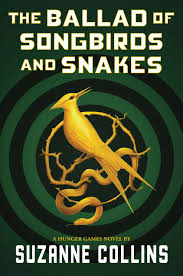
‘The Ballad of Songbirds and Snakes’ by Suzanne Collins was arguably the most-anticipated book of 2020. Fans of ‘the Hunger Games’ have been waiting for a prequel to the best-selling series for years, hungry for more information about the history of Panem (the dystopian future of the United States of America), and the war that was alluded to so many times throughout the trilogy.
Fans speculated that the prequel would be about Mags, the eighty year-old tribute from District 4 who we came to know in the second book, ‘Catching Fire’. So imagine their surprise when we learned the prequel would be about President Coriolanus Snow, the same man who institutionalized the Hunger Games, and killed anyone who came in his way.
Now, anyone who knows me would know that I love a good origin story, so I was excited rather than confused by the prospect of an origin story for President Snow instead of Mags.
At first, I found the teenage Coriolanus Snow to be charismatic and relatable, and in some parts I even sympathised with his situation.
However, as the book progressed, I began to notice selfish ulterior motives lying underneath all his ‘good deeds’, signs of his future personality. I felt that the characteristics of young Snow did not maintain enough continuity – in one chapter he was portrayed as friendly, kind-hearted boy, and in the next he’s a sly, underhanded traitor.
One of the high-points of the book was that it illustrated the brutal Hunger Games from the point of view of the mentors as opposed to that of the tributes. While Coriolanus Snow was depicted as a blood-thirsty monster from Katniss Everdeen (the protagonist of the original trilogy)’s point of view, ‘The Ballad of Songbirds and Snakes’ uncovered a more vulnerable side of the villain.
‘The Ballad of Songbirds and Snakes’ is a fast-paced, action-packed story, however I personally felt that it lacked connections to the ‘Hunger Games’ trilogy, and did not answer enough questions. Why does Snow drink blood? Why did he support the Hunger Games? Why did he laugh while choking on his own blood? Why is he evil in the first place? An origin story is supposed to tell the readers why the antagonist became a bad person, but I thought that this was lacking in the book, and to be honest it was a little disappointing.
Other than that, however, ‘The Ballad of Songbirds and Snakes’ is an interesting read, with subtle references to the original trilogy. I would definitely recommend this book to fans of ‘The Hunger Games.’
 De Omnibus Dubitandum