A Gatsby Never Gives Up
If there is one thing of which I can be certain, it is that a Gatsby never gives up. Never. Even if it seems like there is no hope left.
I was fired from my fifth job since I graduated college. I was told by my boss that I was a ‘lazy, malingering good-for-nothing, who didn’t deserve the prestige of his job’. I find it rather difficult to come up with anything remotely prestigious about a job as a waiter in an unknown café, but I shall let it slide.
You might think that after five jobs one would lose confidence and hope, but not me. After all, we Gatsbys never give up.
So, it shouldn’t come as a surprise that I quickly found a new occupation, one that I was sure I would excel in.
It all started one morning, as I perused the morning newspaper over a rather splendid breakfast of eggs, toast, and tomatoes (more than I could afford, if I might add). There was an advertisement in the paper, about a job as a translator for a French duke, who was coming here, to England. Here was a perfect opportunity for me to get back to work again!
I put on my best suit (a vibrant yellow thing, with white lace at the cuffs and collar), and set out for the interview.
The interview was a short, brief affair. They asked me for my name, which I truthfully told them was Frederick Arthur Gatsby. They then asked me why I wanted a job as a translator, and once again, I told them the honest truth, which was that I was in desperate need of cash. The interviewer was a strange chap. He kept looking at my lovely frilly suit with an air of disdain, and I’m quite positive that he flinched when I told him that I had no prior experience of being a translator. After some more disdainful looks, the man told me I would get the job, ‘but only because there were no other takers’. Of course he was only joking. I’m quite sure that he was delighted to have me. Anyone else for the job would have disappointed him. After all, I doubt anyone else had shown up in such a fabulous suit.
My first day of translating was to be in two days time. I was very excited to have a job as a translator from French to English, and vice versa. I was quite aware, of course, that the only French words I knew were ‘Oui’, ‘Merci’ and ‘Au Revoir’, but I didn’t let such a tiny little drawback bother me.
The day finally arrived. I was dressed in my charming yellow suit again, seated next to the Duke of France, opposite an English Duke, whose name I can’t quite recall.
We Gatsbys are honest chaps, and are never afraid to admit when something goes off to a bad start. Well, I suppose that’s an understatement. The entire interaction went off to a bad start, a bad middle, and an even worse end.
I might have overestimated my ability to intuit what the Frenchman was saying without ever learning the language. There was the additional annoyance of both Dukes glancing at my suit with the same disdainful expression that the interviewer had worn, which was making me rather flustered.
The French Duke jabbered away in French, while my forehead was increasingly becoming wetter and wetter with perspiration. The English Duke looked at me expectantly, obviously waiting for me to translate what the Frenchman had just said.
“Erm,” I stuttered, “well, it’s open to interpretation really, what he said… He didn’t really say anything, you know what I mean?”
The English Duke raised his eyebrows at me, and that was when I noticed that his piercing blue eyes were frightfully intimidating.
“No, no that’s not what I meant,” I whimpered, “he just told you how much he likes… um.. Croissants! Yes, that’s it. He loves croissants and wants them served to him everyday.”
The French Duke was looking at me in a strange fashion. I suppose he didn’t remember saying the word ‘croissant’ in the monologue he had just given. Even the English Duke looked a little sceptical about it all.
By then I was positively drenched in sweat. I asked myself again and again how I had landed myself in such a ridiculous situation, but then I remembered that my yellow suit had been so attractive that the interviewer had absolutely refused to deprive me of the job. Now when I think back, I realise I never should have worn that suit.
I was so caught up in regretting my clothing choices that I barely heard the Englishman speaking.
“Well go on,” he said, “tell him that he can have all the croissants he wants, and more.”
Now I was in really hot water. It had been easy to make something up in English, but how was I supposed to talk to the other Duke in French?
I turned to the French Duke and gulped, in an effort to dampen my throat which was now dry as bone, rendering me incapable of speech.
“O-oui,” I said rather shakily, “Merci. Au revoir.”
The French Duke gave me one long look. After what seemed like an eternity, he turned his head to face the other duke, smiled graciously, and nodded. And then he got up and walked away to his chambers.
Now it was the English Duke’s turn to smile.
“Thank you for your service,” he said to me, “ I will send you your payment in a day’s time.”
Finally, my turn to smile arrived. Somehow, I had managed to bluff my way through this situation, and the outcome was spectacular.
“Thank you, sir” I said, bending low into a sweeping bow.
And with that, I sauntered out of the Duke’s residence, looking extremely dapper in my frilly yellow suit.
A LETTER FROM THE FUTURE
Dear me,
I will not ask you how you are for I already know that you live in a dystopian world where the interactions with fellow human beings are limited to the virtual world, bits of paper have more currency than love and the air is thick with smoke and disease.
I write to you from a future that is different and better. You might not realise it now, but you inhabit the cusp to the new world, brought on by what we refer to in 2030 as the ‘Covid Scare’. A disease that locked us away in our homes unlocked our hearts and minds. We realised that all the money in the world couldn’t save us, unless we took the time to invest in each human being rather than share markets. It is because of this experience that the ideal world as it is now, in the year 2030 is one of respect, tolerance and equality.
In my world the difference between black, brown, yellow and white is restricted to the paint palette alone and we celebrate the myriad colours we live among. We love who our hearts choose regardless of the gender and everyone celebrates that love.
Environment is the new religion as it was even many years before your present time. We know that to live in harmony with mother nature is the only prayer we need. Communal conflict has been replaced by hope and love and people find spirituality inside their own beings and not in temples, churches and mosques.
Remember how you were told to pick history over science because you were a girl? Well, the cure for COVID-19 was developed by a young woman in Delhi. Nobody in this time would even dream of making a distinction based on gender.
We aren’t affluent in monetary terms. Everyone has as much as they need, no more and no less. Life is simple. We grow our own food and share what we grow with our neighbours. We are rich in so many other ways. We are rich in the relationships we have with those around us. We are rich with what we imbibe from art and music and books.
Before it got better, however, it got worse. The police, the so-called ‘protectors’ of the people, murdered their fellow humans in cold blood, just because they were of a different race or culture. The criminal was considered the victim, the victim the criminal. Atrocious crimes against both humans and animals were applauded rather than condemned, and peaceful protestors were arrested instead of real criminals.
You might think that ten years is too little a time to change a bloodthirsty hell into the Shangri-La I claim to live in, but It did happen, though, it wasn’t easy.
Years of death, destruction, and disease caused us humans to finally see the light. People started to speak up. Men, women, children of every religion, took to the streets to protest against those in power, and although these protests were often crushed by the authorities, in the end the people’s will prevailed. Authoritarian governments across the world fell.
What once divided us brought us together, as Audre Lorde said, “It is not our differences that divide us. It is our inability to recognise, accept, and celebrate those differences”.
We’ve learnt to be happy with less, and instead of wasting our time trying to impress people on social media, we have ushered in an age of science, literature, art, and music, but despite the excellence around us, parents no longer pressure their children into being A+ students or prodigies
I am not a world-famous celebrity or the CEO of some big company. I’m just a forensic scientist. I walk to work everyday, and use the same laptop you use now. It might not seem like an ideal world to you, but trust me, it will. I should know, I’m you.
Love,
Nayantara.
How to Make: Glitch Art

The other day, I came across a new style of art, called ‘glitch art’. I decided to try my hand at it, and immediately fell in love! Not only is it fun to make and aesthetically pleasing to look at, it is also easy enough for anyone to make. Glitch art can be a fun pastime during the lockdown for both art-lovers, and those who just want to try it!

All you need:
- A pencil
- A black pen
- A blue pen
- A red pen
- A whitener or white pen
- An eraser
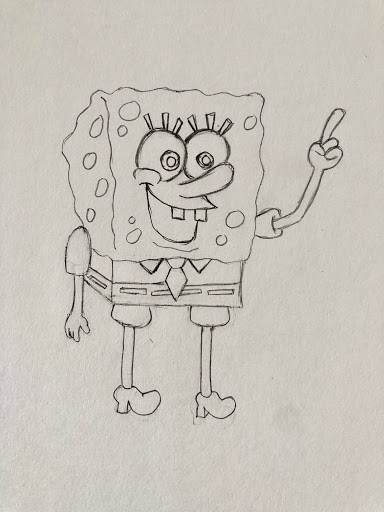
The first step, is to draw anything of your choice with a pencil. I have drawn the well-known cartoon character Sponge-Bob, but this glitch technique can be used on any drawing!
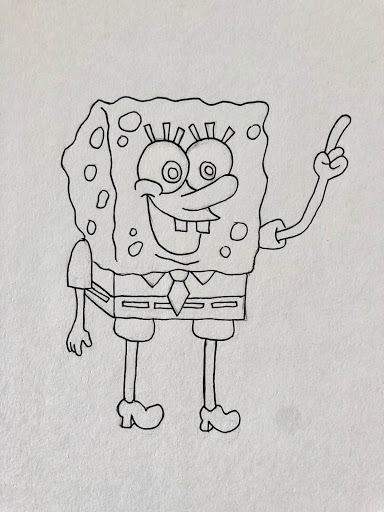
Step two is to outline your pencil drawing with a black pen or marker.

The next step is to outline the drawing with a red pen or marker, but slightly to the left of the original drawing.

The fourth step is to outline the drawing with the blue pen or marker, but slightly to the right this time. After this step, you can see the glitch effect starting to come out!
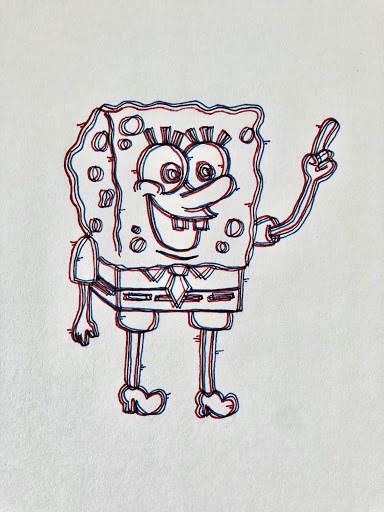
For the next step, add some small lines in and out of the drawing with the blue and red pens. This adds considerably to the glitchy effect!
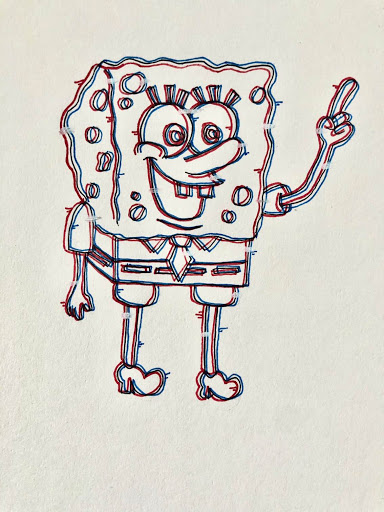
The final step is to use the whitener or white pen to add small gaps between some of the lines.
And there you have it! This technique can be used to add a nice effect to any drawing that you make.
Back To the future
I walked into the portal. My best friend had been working on the time machine for many years. And now that she had finally completed the prototype, I, James Sturrock, as her best friend, was about to test it.
“Be careful James,” said Olivia. “Are you sure you want to do this?”
I nodded firmly. “I am ready.”
With a sigh Olivia pressed a red button on the wall. I closed my eyes. The time machine jerked forward, and my heart lurched. My stomach seemed to do back flips in my belly and I could feel vomit in my throat. Suddenly the time machine came to a stop.
Hesitantly, I ventured out of the machine. Right outside was a bakery, its windows filled with freshly baked bread. Some of the pastries were covered by a bright yellow star painted on the glass, along with the word Jude. On the door was written the word Bäckerei. My third language in school was German, so I knew it meant Bakery. So, I was in Germany, but which time period?
Suddenly, I felt a hand on my shoulder. I looked up. It was a tall man wearing jackboots. His jacket glinted with badges and medallions, the swastika shining proudly on the pocket. Oh no! The yellow star and the ‘Jude’ graffiti had already given me an inkling. Now, the soldier’s uniform had confirmed my worst fears. A chill ran down my spine as I realised I had landed up in Nazi Germany!
“Jude?” asked the Nazi. Using the common sense I still had, I shook my head vigorously. I saluted and shouted “Heil Hitler!” I didn’t want to be killed.
The Nazi smiled and nodded. “Are you in the Hitler Youth, boy?” he asked in German.
I shook my head. The soldier’s smile turned into a frown. He grabbed my arm and dragged me along the road. People were staring at me strangely, probably because of my strange 21st century clothes.
You could tell which ones were Jews, because of their white arm bands and yellow badges with the Star of David on them. I had read a lot about Nazi Germany in books, so I had some idea about what was going to happen to me.
The Nazi pushed me into a line of boys, and whispered into my ear, “Hitler Youth.”
“Name?” The Nazi in charge of the boys asked me.
I couldn’t let them know I was British, or they would shoot me down where I stood. Thankfully, with my blond hair and blue eyes, I was the perfect ‘Aryan’ example in their eyes.
“Umm… Fritz. Fritz Müller.” I made up my name on the spot. The officer wrote it down in his notebook.
Staying in Nazi Germany would be very dangerous. So, I had to get back to the time-machine, somehow.
“A British pilot has crashed here in Berlin,” said the head Nazi. “He is hiding somewhere. Jungvolk, find him! Heil Hitler!”
The entire group shouted, “Heil Hitler!” enthusiastically, and ran off in different directions to look for the pilot.
This was bad. If the Hitler Youth found the pilot, they would shoot him, or worse put him in a gas chamber. My great-grandfather had been a young pilot during the second World War and had crashed in Berlin. He never returned and no one knew what happened to him.
I wasn’t going to let the same thing happen to this pilot. I had to find him first and get him to safety. I followed a group of boys who were running towards the hills, which is where they were sure the pilot would be hiding.
The boys tore apart the bushes and searched behind the trees. A short boy came up to me.
“Hey, what about the deserted church at the edge of the city? He might be hiding there,” the boy said.
“You stay here. Don’t bring the rest of the boys,” I told him. “It’ll be easier to find the pilot if there’s only one person. Otherwise he might hear us coming”
The boy nodded.
I ran towards to the church asking for directions on the way. The Hitler Youth uniform, that the Nazis had given me, was so intimidating that people gladly helped. Once inside the church, I searched it to look for the pilot. After I had covered quite a bit of the building I found a trail of blooding leading to the back of the church.
There he was! A tall broad-shouldered man was leaning against the pillar. His head was bandaged and so was his arm. His face was covered in bruises and one eye was red.
He saw me and groaned.
“So, they finally got me. Eh?” he said in English. “I thought they wouldn’t look for me here.”
“No, I am not German. My name is James Sturrock, and I am British,” I said. “Come with me and I will get you to safety.”
“Well! What have I to lose?” said the pilot.
He got up with great difficulty and leaned against me. He was so heavy that I groaned under his weight, but I managed to get him out of the church as fast as I could.
It was already dark as we were about to leave the church gate. My plan was to try and take him, in the cover of darkness, to the bakery where the time-machine had brought me. And, if anyone stopped us, I would have shown my Hitler Youth badge and told them that I had captured the British pilot and was taking him to the Gestapo.
Finally, after walking for almost a mile, we reached the Jewish Bakery. Thankfully, the time-machine was still there, right next to the garbage dump.
We got into it as quickly as we could and shut the door. It was pretty cramped with two of us inside. I pushed the lever that Olivia had showed me, that would take us back to the future.
The pilot and I groaned as the time-machined lurched and jostled and came to a stop with a loud thud.
When I opened the door and stepped out, I saw my entire family had turned up in Olivia’s laboratory. They were looking worried and cross. Olivia looked crestfallen. Clearly, they had blamed her for my sudden disappearance.
“Don’t worry guys!” I shouted as I emerged out of the time-machine. “I am absolutely fine. I had a great adventure, and I think you will agree I did something good too.”
I waved at the time machine with a flourish as the injured British pilot came out of the door. He looked around at everyone and all of Olivia’s high-tech machines with bewilderment.
But, the real surprise was yet to come.
My grandmother stood up from the chair she was sitting on and exclaimed “Papa?!”
An Interview With Anurupa Roy of Katkatha
When you think of what you want to be in life chances are the usual suspects pop into your mind. Lawyer, Engineer or doctor perhaps? But what if you want to do something which is different, off beat, out of the box. Something which will make you want to get up for your work. How do you find what you are passionate about?
There are some uncommon and extraordinary things that you can do keeping your interests and passions in mind. This interview is the first of a series of interviews that I will be doing with interesting people with different careers, and hopefully they will be able to answer some of these questions.
A few weeks ago, I took part in a workshop with Ms. Anurupa Roy, the founder of the ‘Katkatha Puppet Arts Trust’, and I learnt how to make a puppet theatre in a box.
I asked her a few questions that I had about puppetry and she gave me some very interesting and insightful answers. For anyone who is interested in art, and would like to take it up later in life, Anurupa ma’am gives her input via her passion for puppetry. Please do subscribe to my Youtube channel to get updates on the latest content.
An Interview with Anurupa Roy of Katkatha Puppet Arts Trust. If you click and view this video in my Youtube channel, I have provided time codes for each question so you can click and jump to any question you would like to listen to. In case you want to watch Anurupa ma’am’s paper theatre ‘The Girl in the Pink Frock’, here is the link: https://youtu.be/RycAYgtGblg
Welcome!
Hello everyone! My name is Nayantara but you can call me the Artful Writer. No, I am not bragging about my writing skills. I call myself the Artful Writer simply because I love both art and writing. It is also a little spin on one of my favourite book characters – Dickens’ The Artful Dodger.
This blog is going to have a bit of everything I like. Some writing, a little about the books I am reading, lots of art and music too. In time, I am sure there will be a lot more interactive stuff.
For now, do take the time to look around, and thank you for being here.
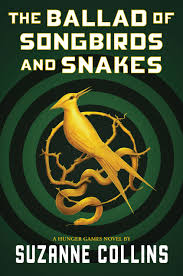
The Ballad of songbirds and snakes : A review
Ambition will fuel him.
Competition will drive him.
But power has its price.
‘The Ballad of Songbirds and Snakes’ by Suzanne Collins was arguably the most-anticipated book of 2020. Fans of ‘the Hunger Games’ have been waiting for a prequel to the best-selling series for years, hungry for more information about the history of Panem (the dystopian future of the United States of America), and the war that was alluded to so many times throughout the trilogy.
Fans speculated that the prequel would be about Mags, the eighty year-old tribute from District 4 who we came to know in the second book, ‘Catching Fire’. So imagine their surprise when we learned the prequel would be about President Coriolanus Snow, the same man who institutionalized the Hunger Games, and killed anyone who came in his way.
Now, anyone who knows me would know that I love a good origin story, so I was excited rather than confused by the prospect of an origin story for President Snow instead of Mags.
At first, I found the teenage Coriolanus Snow to be charismatic and relatable, and in some parts I even sympathised with his situation.
However, as the book progressed, I began to notice selfish ulterior motives lying underneath all his ‘good deeds’, signs of his future personality. I felt that the characteristics of young Snow did not maintain enough continuity – in one chapter he was portrayed as friendly, kind-hearted boy, and in the next he’s a sly, underhanded traitor.
One of the high-points of the book was that it illustrated the brutal Hunger Games from the point of view of the mentors as opposed to that of the tributes. While Coriolanus Snow was depicted as a blood-thirsty monster from Katniss Everdeen (the protagonist of the original trilogy)’s point of view, ‘The Ballad of Songbirds and Snakes’ uncovered a more vulnerable side of the villain.
‘The Ballad of Songbirds and Snakes’ is a fast-paced, action-packed story, however I personally felt that it lacked connections to the ‘Hunger Games’ trilogy, and did not answer enough questions. Why does Snow drink blood? Why did he support the Hunger Games? Why did he laugh while choking on his own blood? Why is he evil in the first place? An origin story is supposed to tell the readers why the antagonist became a bad person, but I thought that this was lacking in the book, and to be honest it was a little disappointing.
Other than that, however, ‘The Ballad of Songbirds and Snakes’ is an interesting read, with subtle references to the original trilogy. I would definitely recommend this book to fans of ‘The Hunger Games.’
A story box performance
Last week I had the privilege of attending a story box workshop with one of the best known puppeteers in India. Anurupa Roy. The project was to “make magic out of the mundane” Using only things we had lying around the house. We had to write a story and create the scenes and characters. Mine was a short one and a half minute production. My original story Writer’s Block is available under the ‘FICTION’ section.
If no one heeds your call, walk alone
In India’s darkest hour, when brother killed brother on the street,
The Mahatma’s belief in ahimsa, faced the biggest challenge it could meet.
“I will not accept failure,” said he. “If needed, I’d rather choose death.”
“Violence, I will conquer with love, or keep trying till my last breath”
Hundreds were butchered in Noakhali and thousands of victims had fled,
Hatred & fear filled hearts and minds, as the once peaceful land bled.
The Mahatma walked undaunted, though paths had been flooded to stop him,
He walked alone through scorched villages, hearing tales agonising & grim.
“Don’t leave, be brave,” he told all. “Remember you are brothers in arms,
Our religions teach us to love each other, not wish each other harm.”
His message brought people together, bringing peace to the troubled land,
The Mahatma’s moral courage, even the coldest heart could not withstand.
Gandhi ji had shown the world, ahimsa’s immense strength and power,
History still remembers Noakhali, as the Mahatma’s finest hour.
By: Nayantara Maitra Chakravarty
 De Omnibus Dubitandum